Search

Thursday, October 9

Improving Literacy Outcomes in Children who are Deaf or Hard of Hearing

Drew's Dad and I were finally able to attend Deaf Initiatives Navigating Your Child's Future presentation this past weekend. The presentation was supposed to take place back in March, but was postponed due to a snow storm.

One of the areas we have been concerned about is literacy. As the parent of a newly diagnosed child with hearing loss, it can be startling to learn that many deaf and hard of hearing individuals only reach a third to fourth grade reading level. I have learned that this is often because deaf or hard of hearing children are taught "whole word" reading, where they actually memorize the look of the word. Whereas, typical reading skills are developed by phonics, but required the ability to hear and say all 47 phenoms of the English language. With technology providing many options for proper amplification for our deaf or hard of hearing children, through cochlear implants and digital hearing aids, these outcomes will improve.

Karen Roudybush gave a wonderful presentation on "Bringing Literacy Home," which provided me with many activities and ideas on how to help establish a strong foundation for literacy. She shared with us that research demonstrates that the size of a child's vocabulary is a strong predictor of future reading skills, so it is important to develop a large vocabulary early on. Giving children rich language experiences throughout the day by telling and reading stories, describing the world around them and expanding on word choice (big, huge, giant, jumbo) are all ways to expand a child's vocabulary. She even gave us some activities that we can do to help expand our child's vocabulary:
  • Write on several pieces of paper different words describing "something", for example: small, tiny, little, minute. Then have your child rank the different words in terms of which one is smaller than the other. To me, minute describes something very, very small, where as tiny would mean something a little bit bigger than minute. This expands on a child's vocabulary and gives them additional ways to describe something that is small.
  • Grocery Shopping: She suggested that we always have a grocery list when shopping! (More work for me!) Hand the list to the child, complete with the word written out, and maybe a small sketch or drawing of the object. Then, have the child help you find the item in the store. This can be done even with very little children, and will help them learn to identify key grocery items, and expand their food vocabulary.
  • Purchase small Dry Erase boards and place throughout the house. Write little notes on them each day for your children. Something like, "I love you!" or "School Today" will help children learn how to read (left to right, top to bottom) and will help them realize when letters are upside down and how letters are put together to form words and sentences.

She also gave several book selections that will help enhance vocabulary and literacy. There are many different types of books, so it is important to know what you want to work on when reading. For example, if you want to work with your child on sequencing of the days of the week, a book like Cookie's Week is excellent. She gave several selection idea. I know our family has some book shopping to do:

Kathy also suggested reading books that revolve around daily routines, like bedtime, books about the changing seasons, classic stories, like The Three Bears or The Three Little Pigs, and series books, like Curious George. (Kohl's Cares for Kids is an excellent program, and is currently promoting the Curious George series. It is a great opportunity to purchase the books and toys at a great price, while giving back to the community.)

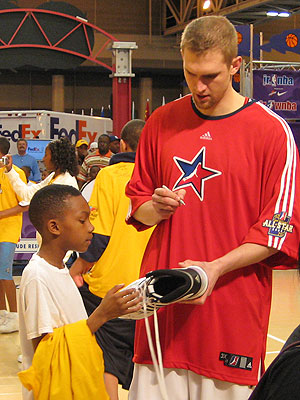
First Deaf NBA Basketball Player Lance Allred Cut


I just heard on the radio that Lance Allred, the first deaf NBA basketball player was cut by the Cleveland Cavaliers. We wrote about him in March when Lance was first signed by the Cavs and then later detailing his battle with bigotry and discrimination.

Lance is currently writing a book detailing his life growing up in a polygamist sect in Utah, and how he dealt with his hearing loss. We wish him the best of luck in signing with another team, or with whatever he chooses to do next.

Wednesday, October 8

What Did You Say?

The list of questions I never thought I would hear just got longer.

While standing on the elevator at Children's Hospital one day, a lady on the elevator looked at me and asked, "What is that crap on your son's head?"

I'll let you guess how I responded.

Monday, October 6

An Amazing Experience: Meeting MLB Pitcher Jim Abbott

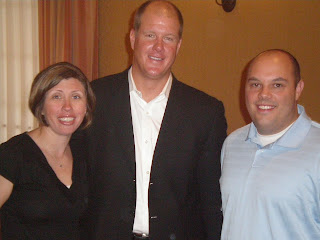
On a recent trip to California, Drew's Dad and I met Olympic Gold Medalist and former Major League Baseball pitcher Jim Abbott. We were fortunate enough to attend a meeting my company was holding where Jim was the keynote speaker. It was such an amazing experience to listen to him speak about his ability to become a successful baseball player, against all odds.


Born without a right hand, Jim Abbott defied all of the odds to become a major league baseball pitcher. Despite being born with a disability, he truly believes that more has given to him than was ever taken away by his birth defect. He talked to our group about the need to A.D.A.P.T. in order to overcome our circumstances and achieve our goals:

  • Adjustability: Thinking of a different way to do things, given your circumstances. For Jim, he had to make adjustments just to be able to tie his shoes. For Drew, we use a food saver to water proof his cochlear implants for swimming. No matter what the circumstance, little adjustments can make just about any situation work.
  • Determination: We are constantly told about the things we can not do. If we start to believe that we can not do something, it limits our abilities. We must filter out all of the negativity in order to reach our goals.
  • Accountability: Never let the circumstances of life be an excuse for not meeting your goals. You are accountable for your actions. Have you made the most of your talents today?
  • Perseverance: At times, your goals may not seem possible. But so much is possible if you just hang on to your goal and keep working!
  • Trust: The ability to know that you are prepared and can do anything! Bring trust into every situation! You can achieve just about anything if you trust in your abilities.
During the presentation, Jim demonstrated little adaptations he had to make in order to be able not only to pitch, but field his position. He showed us how he would get his glove back on after pitching the ball, in order to field his position. In fact, I was the one that got to play catch with him during this part of the presentation! Check playing catch with a New York Yankee pitcher-that-threw-a-no-hitter off of my "to-do" list!

This presentation was designed to speak to my inner "sales representative" soul, in a time of economic strife, but instead struck special cord as a mom of a child with special needs. There were points during his presentation where I could feel myself tearing up. What did Jim's parents do to raise such a strong, secure, determined son? How had Jim handled being made fun of for being and looking different? When did Jim learn of his disability, and what did his parents tell him about it? There were so many questions that ran through my mind. I wanted to learn as much as I could from him on how I can impower Drew to be self-confidant, determined, successful and proud of being different.

Fortunately, Drew's Dad and I were able to spend a considerable amount of time one-on-one with Jim, and were able to talk about our personal situation. We asked Jim if he could give us any advice on how to empower Drew. Jim told us of his Dad, and that one of his dad's key motto's to him was "Be a leader today!" Jim's Dad talked with him each day about the choices he had to make, and that if Jim was a leader, all of his friends and classmates would follow.

Jim also spoke of how being a part of a team, as baseball provided, was a great way to help him "fit in". He strongly encouraged having Drew participate and lead in team sports, which would lead to acceptance without questioning his differences.

If you believe in yourself, nothing can stop you, and then amazing things can happen. We left with an autographed baseball: "To Drew, Anything is Possible!" Jim Abbott

***Drew's Dad here...I just wanted to add this video in case one of you hadn't heard of Jim Abbott. Enjoy!***

Saturday, October 4

Moving Forward

I should not have left that last post up for so long. We have been extraordinarily busy, and while the list of blog ideas is rapidly growing in my mind, I just haven't had time to write. I shared with you this struggle we are going through for several reasons, but mostly because someone reading may encounter a similar situation in the future. We have created such a valuable support network through this blog, complete with your help in the comments, that we hope to help someone else in the future.

Drew's Dad and I decided to have a meeting with the manager of our speech therapist, to discuss the concerns we shared with you in my last post. We decided to do this quickly, as we didn't want to go much longer without sufficient resources. Drew was without therapy much of the summer, and the first month of the fall was not good. So instead of waiting, and leaving Drew in a poor situation, we decided to voice our concerns. Our talking points were:

  • We were left without services for two months, waiting on a replacement therapist, which we were told would have significant experience with hearing impaired children following an AVT approach. Our expectation is that we are provided with a therapist equal to the level of service we were receiving.

  • Drew's current level of listening and speech is irrelevant to the conversation.

  • The new therapist clearly did not review information on Drew prior to our first appointment. She had no knowledge of his current language skills, implant history or current goals. She did not develop any goals with me.

  • Therapy is needed to provide me with techniques that will facilitate higher order thinking and advance language. I need her to coach me on listening and language techniques and provide “homework material” that will enforce key concepts. Drew is awake an average of 84 hours a week, but only spends one hour in therapy.

  • I need to see a clear lesson plan for Drew, with age and language appropriate activities that will push Drew to the next level in his listening and learning. I expect a session to have an observation period where we discuss things that are going well and things that we need to work on. This should be followed by a period of action, where specific techniques and activities are introduced to help Drew reach the next level in his listening and spoken language development. Finally, the session should include a period of reflection where we decide if this activity elicited the response we were looking for, and then a summary of what we did today with discussion on how we can incorporate into daily play.

  • Provide homework and written notes from the session within 24 hours.

Your comments and suggestions were very helpful to me in establishing this outline for our meeting, so I thank you. I think many of you would be surprised by the way our therapy sessions have been structured, and I use that term loosely. There has been no discussion, no plan for the session, no notes, no homework and the list goes on. Our concerns, however, are going to be addressed in a timely manner, which we hope will bring back the left of service to which we are accustom. Many changes should be in place by our session this week.

The most immediate change will be to follow the typical session agenda, as presented above. The manager we spoke with thought this was the way the sessions were being run, and seemed quite surprised that the sessions actually had no structure or focus. In addition, we will be provided session notes within 24 hours of the session. I am very pleased with all of this.

In addition, we discussed the need for a more experience based therapy. Drew really enjoys activities, and it seems fitting to provide him with activities that would enrich his language while doing something fun. For example, one we did in the past, when he was a bit young to really take a lot from it, was to glue different objects with different textures to a piece of paper. We used words like soft, hard, fuzzy, prickly, tough, slick, just by using simple items off of the shelf of a Jo Ann Fabric store. It was an excellent activity, where Drew didn't even know he was learning! The goal is to establish a theme each month that will incorporate these types of activities. For example, October will be "All About Fall," with a pumpkin carving, leaf project and spooky story. We are really looking forward to seeing this implemented, as Drew is at the perfect age to enjoy these activities!

Overall, we feel very positive that the level of service will be improved. I would encourage anyone going through a similar situation to discuss their concerns. Our experience is that they generally want to provide the best service possible for our children, and with constructive feedback, they can make them better for all of our children.